
We Compared Legal Consulting Firms for Crypto Business in Canada
FINTRAC has regulated crypto services in Canada since 2014. No minimum capital. Foreign companies can register without a physical office. The system looks simple on paper.
The reality involves more. FINTRAC wants a full AML program before they review your application. The Travel Rule applies to crypto transfers above 1,000 CAD. CSA oversight kicks in when tokens cross into securities territory. Banks still treat crypto firms with caution.
Finding the right legal consulting firm for crypto business changes the outcome. The firms on this list have done Canada MSB registrations multiple times. They know which compliance officers FINTRAC trusts. They know which banks open accounts. They know which documentation gets approved and which gets rejected.
Here is how six top crypto license service provider firms compare for Canada in 2026.
How They Stack Up
Finding the right legal consulting firm for crypto business means looking at more than just their website. The table below pulls together the key differences that separate these six firms.
| Firm | Canada Office | Published Pricing | Verified Client Win | Specialization |
| Gofaizen & Sherle | Yes | Yes (9,800–15,200 USD) | Trustpilot reviews, Basal Pay | Multi-jurisdiction with Canada base |
| Lawrange | No | Not listed | Not specified | Canada MSB only |
| Key2Law | No | Not listed | Not specified | Canada + international |
| Adam Smith | No | Not listed | 1,000+ licenses reported | High-volume licensing |
| COREDO | No | Ready-made MSB: 40,000 EUR | Not specified | EU + Canada with shelf companies |
| Fast Offshore Licenses | No | Yes (9,800 USD) | Not specified | Transparent offshore + Canada |
Those numbers and categories only tell part of the story. Here is what each firm actually delivers when you hire them.
1. Gofaizen & Sherle
Gofaizen & Sherle maintains a registered address in Canada that doubles as a working office. When FINTRAC requests an in-person discussion, the team arrives within hours, not days. That proximity eliminates the delays foreign-based firms face.
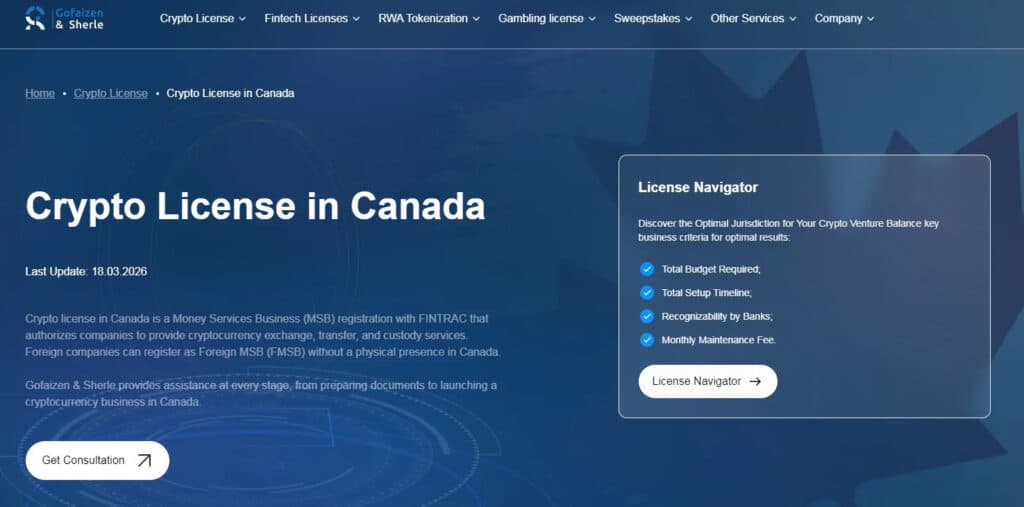
The team at Gofaizen & Sherle, crypto lawyers in Canada, has worked on many licensing matters across more than 50 countries.
That depth of experience means they have seen how regulators in each jurisdiction review applications differently.
Their Canada operation connects to offices in Europe, Asia, and Latin America. A client who wants MSB registration today and expansion into the EU next year works with the same team throughout, making them a trusted legal service to obtain a crypto license across multiple markets.
What the comparison revealed:
- Three service tiers match different client situations. The 9,800 USD option works for existing companies that only need the MSB registration. The 13,000 USD package adds company formation and a local director. The 15,200 USD tier includes corporate account setup with banks that accept crypto clients.
- The Crypto License Navigator runs jurisdiction comparisons based on four criteria: total budget, expected timeline, whether banks in that country open accounts for crypto firms, and monthly maintenance costs. Gofaizen & Sherle experts recommend running your business model through the tool before filing any application.
- Trustpilot reviews mention specific outcomes. One client said the firm delivered “clear guidance on regulatory compliance and contract negotiations” with “responsiveness, attention to detail, and ability to navigate intricate legal challenges.” Another client noted the team set up a dedicated follow-up group after the license arrived and handled post-query issues with “incredible speed.”
- Their crypto lawyers manage both FINTRAC and CSA applications separately. Some platforms need only MSB registration. Others need securities approval for token offerings. The firm runs both tracks in parallel when clients require both.
Where they stand: Gofaizen & Sherle works best for crypto exchanges and tokenization platforms that want MSB registration with the ability to add other jurisdictions later, plus the reliability of a firm with boots on the ground in Canada.
2. Lawrange
Lawrange keeps their focus narrow. Canada MSB registration sits at the center of everything they do. Their website lists Canada and nothing else. Every guide, every service page, every contact form points to one goal: getting crypto firms registered with FINTRAC.

Their guides walk through the registration steps in straightforward language. Dense legal paragraphs get replaced with clear explanations. Requirements that usually get buried in fine print sit out in the open. That kind of clarity comes from submitting applications repeatedly, not from reading FINTRAC’s website once.
What the comparison revealed:
- A checklist system tracks every document FINTRAC expects. Clients work through the checklist before submission. Nothing gets left out. Nothing gets added that FINTRAC does not ask for.
- Experience with both MSB and FMSB applications. The difference matters for foreign companies. Lawrange knows exactly what documentation FINTRAC requires from non-resident applicants versus Canadian-registered firms.
- Compliance officer appointments get structured with FINTRAC’s preferences in mind. Foreign companies using FMSB status have more flexibility, but the compliance officer still needs to be reachable during Canadian business hours. Lawrange helps clients structure that role correctly.
- Banking work focuses on recent approvals. They track which financial institutions in Canada have accepted MSB-licensed crypto clients in the past year. That list changes. Their information stays current.
Where they stand: Lawrange works best for foreign crypto companies that want Canada market access without establishing physical presence, plus firms that prefer working with a specialist who does not divide attention across multiple jurisdictions.
3. Key2Law
Key2Law handles licensing work on both sides of the Atlantic. Their Canada MSB packages sit on the same website page as their offerings for Lithuania, Poland, and various offshore jurisdictions.
The firm begins with corporate structuring. Choosing the Canadian province comes first. British Columbia and Ontario show up most frequently in their completed projects. From there they move to FINTRAC paperwork and the compliance systems that need to operate behind the scenes.
What the comparison revealed:
- Dual registration scenarios get handled together. Some crypto firms need MSB status for exchange operations and securities registration if they list tokens classified as investment contracts. Key2Law manages both applications concurrently rather than sequentially.
- Compliance officer designation packages pay attention to reporting lines. FINTRAC asks who the compliance officer reports to and whether that person has budget authority for AML systems. Key2Law documents those relationships clearly.
- Banking access tracking focuses on which Canadian banks have opened accounts for crypto clients in the past six months. Banking access changes frequently. Their list gets updated after each successful client onboarding.
- Ongoing compliance service includes a regulatory alert system. When FINTRAC updates guidance or CSA issues new notices, clients receive summaries with action items. No digging through regulator websites required.
Where they stand: Key2Law works best for international crypto businesses that need Canada MSB registration alongside securities compliance for token offerings.
4. Adam Smith
Adam Smith built their practice in Lithuania before expanding into North America. Their Canada team now handles both domestic MSB registration and FMSB status for foreign companies serving Canadian customers from abroad.
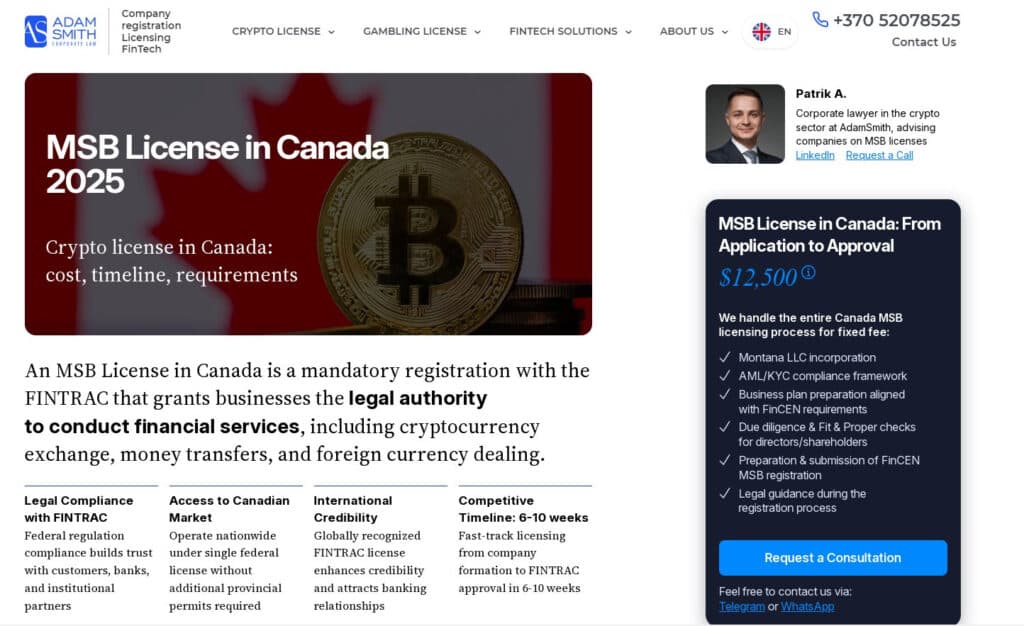
The firm has completed crypto licensing work for clients across multiple countries. Their internal records show more than a thousand such projects. That volume means their team has seen regulator questions from dozens of jurisdictions and knows what documentation holds up under scrutiny.
What the comparison revealed:
- Canada MSB applications where the client operated entirely outside North America. Foreign MSB status allows that. Adam Smith knows which documentation FINTRAC accepts from non-resident applicants versus what triggers additional scrutiny.
- A database of FINTRAC feedback from past applications. When a regulator asks for clarification on a specific policy section, that information feeds into future submissions. Clients benefit from what previous applicants went through.
- Post-license service includes a compliance calendar that tracks reporting deadlines. FINTRAC requires suspicious transaction reports within specific timeframes. Annual audits have fixed due dates. The calendar prevents missed filings.
- Location in the EU gives them direct experience with MiCA implementation. Canada’s regulatory framework operates differently, but the underlying AML principles overlap. Clients moving from European markets to Canada deal with one team instead of two.
Where they stand: Adam Smith works best for European crypto firms already operating under MiCA who want to add Canada MSB registration without switching to a new provider.
5. COREDO
COREDO operates out of Prague with a practice that spans European and North American licensing. Their legal crypto consulting covers MSB registration through FINTRAC, which they have documented in published guides on their website.
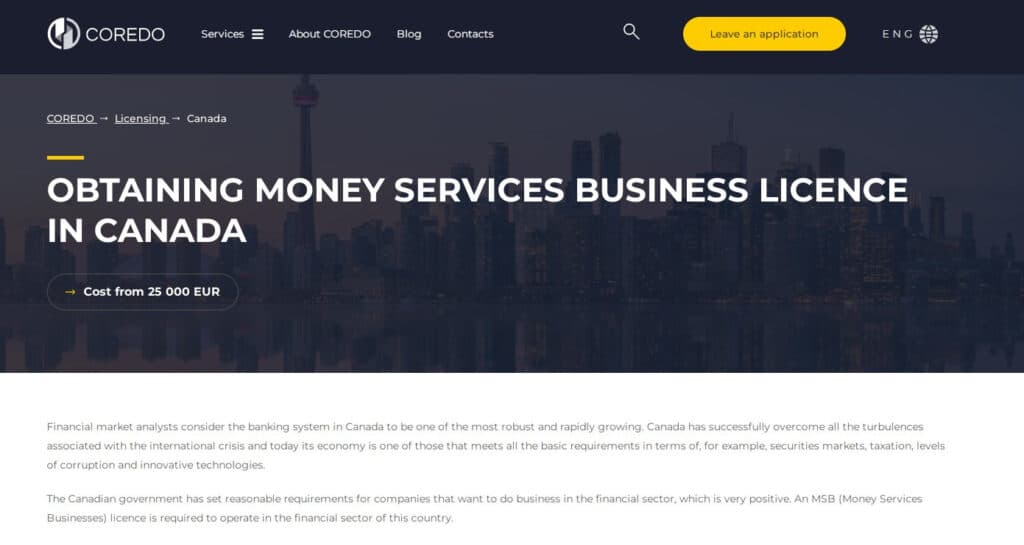
The firm maintains an inventory of licensed entities ready for acquisition. One current listing shows a British Columbia company with MSB status obtained in July 2023. Permitted activities include money remittance, virtual currency dealing, currency exchange, and operations by payment service providers. The asking price sits at 40,000 EUR with change of ownership included.
What the comparison revealed:
- A jurisdiction selection matrix runs on six criteria: regulatory regime, cost timelines, substance requirements, banking ecosystem, tax predictability, and sanctions risk. They rank each option before recommending a jurisdiction.
- Crypto-specific AML controls get implemented including PEP screening, OFAC and international sanctions list checks, EU sanctions screening, and KYT with case management for suspicious activity reports.
- Compliance framework follows FATF standards and EU rules while adapting to FINTRAC requirements. They integrate AML software and regulatory technology tools to automate monitoring.
- Published analysis on EU financial regulation for 2026 shows more than 60 new directives and regulations related to financial regulation, AML, and digitalization taking effect across the EU. EBA data cited in their analysis shows AML violation fines increased 38 percent in 2025 compared to the previous year.
Where they stand: COREDO works best for companies wanting to acquire an already-licensed Canadian MSB rather than going through the application process from scratch, plus ongoing compliance support afterward.
6. Fast Offshore Licenses
Fast Offshore Licenses puts their Canada pricing right on the website. No calls needed to get a number. The MSB package starts at 9,800 USD. Their lawyers for obtaining crypto license handle everything from company formation to regulator communication.
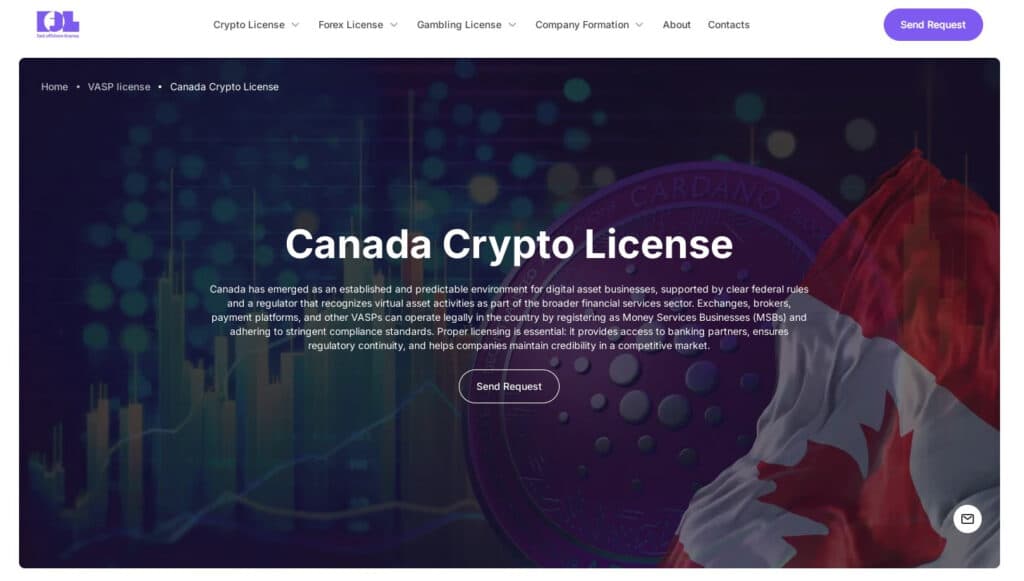
Fast Offshore Licenses started with offshore jurisdictions like Panama and the Cayman Islands. Over time, clients kept asking about Canada. The firm added MSB registration to its offerings because the demand would not stop. Their team now handles both traditional offshore work and Canada applications under one roof.
What the comparison revealed:
- One price wraps everything together. Company formation. AML/KYC policy drafting. Regulator communication. No hourly billing. No line items that surprise clients later.
- MSB versus FMSB distinction gets handled from day one. Foreign companies serving Canadian customers remotely qualify for FMSB status. Fast Offshore matches clients to the correct registration type immediately.
- Banking access gets built into the service. They track which Canadian banks have accepted MSB-licensed crypto clients recently. That list changes. Their information stays current.
- Post-license support includes automatic audit scheduling. FINTRAC requires annual independent audits. Fast Offshore sets them up without clients having to remember the deadline.
Where they stand: Fast Offshore Licenses fits startups and lean operations that want to know the total cost before signing anything. No hourly billing. No invoices that climb month after month. Just a flat price and a clear path to the license.
What the Numbers Tell Us
Comparing these six firms side by side reveals patterns that matter for decision-making.
First, pricing transparency varies. Gofaizen & Sherle and Fast Offshore Licenses publish their Canada packages online. Lawrange, Key2Law, Adam Smith, and COREDO require direct contact for pricing. That does not indicate quality. It does indicate how each firm structures their sales process.
Second, physical presence in Canada separates Gofaizen & Sherle from the rest. Every other firm on this list operates remotely. For most foreign companies, that works fine. For clients who anticipate in-person meetings with FINTRAC, a local office matters.
Third, ready-made options exist. COREDO offers an MSB-licensed company for sale at 40,000 EUR. That bypasses the application process entirely. Other firms focus on obtaining new licenses.
Fourth, volume tells a story. Adam Smith reports over 1,000 completed crypto licenses. Gofaizen & Sherle has worked across 50+ jurisdictions. Lawrange focuses exclusively on Canada. Each firm built their expertise in different ways.
Making the Choice
The right legal consulting firm for crypto business depends on what you need.
If you want a firm with a physical Canadian office and global reach, Gofaizen & Sherle fits. If you prefer a specialist who does nothing but Canada MSB work, Lawrange fits. If you need both MSB registration and securities compliance for token offerings, Key2Law handles both.
If you are coming from Europe with MiCA experience, Adam Smith bridges the gap. If you want to buy an already-licensed company rather than apply, COREDO has inventory. If you want transparent pricing upfront, Fast Offshore Licenses publishes theirs.
All six deliver MSB registrations. The difference shows up in how they work, what they charge, and what else they offer beyond the license.
Final Thoughts
Canada offers one of the most accessible paths to crypto licensing among developed nations. No minimum capital. Foreign companies welcome. A regulatory framework that has operated since 2014. Banks that recognize FINTRAC registration.
But accessibility does not mean simplicity. FINTRAC demands real compliance. The Travel Rule requires technical implementation. CSA oversight adds another layer if your assets cross into securities territory.
The six firms ranked here all deliver MSB registrations. That is the baseline. The difference shows up in the details. Some build compliance programs that keep clients approved year after year. Some move to the next project and leave clients on their own.
When you pick a specialized legal firm for obtaining crypto license, ask about the Travel Rule implementation. Ask about annual audits. Ask about what happens when FINTRAC updates their guidance.
The best legal consultants for crypto licensing are the ones who treat your license as an ongoing responsibility, not a one-time transaction.