6 Best ASPM Platforms for Security Teams in 2026
Security teams have spent years getting better at finding vulnerabilities. That was never the hard part. The hard part is deciding what deserves attention first.
A modern organization may receive findings from SAST tools, dependency scanners, cloud security platforms, container scanners, penetration testing tools, secrets scanners, and dozens of other security sources. The result is not a lack of visibility. If anything, the problem is too much visibility.
Thousands of findings appear. Only a fraction of them are likely to matter today. This challenge has helped turn Application Security Posture Management (ASPM) into one of the fastest-growing categories in application security. Instead of creating more alerts, ASPM platforms attempt to answer a more practical question:
Which risks should we actually fix first? Many organizations that begin researching Snyk alternatives eventually arrive at ASPM for exactly this reason. They are not necessarily looking for another scanner. They are looking for better prioritization.
The platforms below are among the most widely discussed ASPM solutions in 2026.
Why ASPM Exists in the First Place
Most security teams already own security tools. Often, they own too many. The challenge is that each tool sees only part of the picture.
A SAST platform identifies insecure code patterns. An SCA tool highlights vulnerable dependencies. Cloud security tools identify exposed infrastructure. Runtime systems reveal active risks. Vulnerability scanners generate another stream of findings.
Individually, these tools provide useful information. Collectively, they create a prioritization problem. ASPM platforms sit above those systems and attempt to connect the dots.
Rather than asking: “How many vulnerabilities do we have?” They focus on: “Which vulnerabilities represent meaningful risk?”
What To Look For in an ASPM Platform
Not every ASPM platform approaches prioritization the same way. Some focus heavily on risk scoring. Others emphasize asset relationships, ownership tracking, remediation workflows, or developer collaboration.
The strongest platforms typically provide:
- Asset inventory visibility
- Risk-based prioritization
- Vulnerability correlation
- Security posture management
- Remediation workflows
- Developer collaboration
- Cloud and AppSec visibility
- Executive reporting
The best choice often depends on how mature a security program already is.
1. Aikido
Many ASPM platforms begin with visibility. Aikido approaches the problem from a slightly different angle. The platform starts by asking whether security teams actually need another source of findings. For many organizations, the answer is no.
What they need is a clearer understanding of which findings deserve immediate attention and which can safely wait. Aikido combines application security, cloud security, runtime protection, vulnerability management, AI-powered pentesting, supply chain security, container security, secrets detection, and remediation workflows into a unified platform. Findings are automatically correlated and prioritized based on real-world exposure and risk.
The result is less time spent reviewing alerts and more time spent resolving issues that matter.
Capabilities include:
- ASPM
- SAST
- SCA
- Cloud security
- Secrets detection
- Container security
- Runtime protection
- AI pentesting
- Vulnerability management
- AutoFix remediation
For organizations seeking both detection and prioritization within a single platform, Aikido is often one of the strongest options available.
2. ArmorCode
Some security teams are not trying to replace existing tools. They are trying to make sense of them. ArmorCode was built around that reality.
The platform aggregates findings from a wide range of security products and uses contextual analysis to help teams prioritize remediation efforts. Instead of replacing existing security investments, the platform attempts to create a centralized view across them.
Capabilities commonly include:
- ASPM
- Security data aggregation
- Risk-based prioritization
- Asset visibility
- Workflow orchestration
- Executive reporting
Organizations with large and diverse security stacks frequently evaluate ArmorCode.
3. Nucleus Security
Security programs often struggle with fragmentation. Findings exist in multiple systems. Ownership is unclear. Remediation efforts are difficult to track across teams.
Nucleus Security attempts to address those operational challenges by creating a centralized environment for vulnerability management and prioritization.
Rather than concentrating solely on detection, the platform emphasizes workflow management and remediation visibility.
Capabilities include:
- ASPM
- Vulnerability aggregation
- Risk-based prioritization
- Asset management
- Remediation tracking
- Executive reporting
Organizations seeking stronger operational visibility often consider Nucleus Security during evaluations.
4. Veracode
Veracode built its reputation long before ASPM became a major category. As application security programs matured, organizations increasingly wanted more than testing capabilities alone. They wanted broader visibility across application risk and stronger governance around remediation efforts.
That evolution naturally pushed many vendors toward posture management capabilities. Today, Veracode continues to be evaluated by organizations seeking a combination of testing, governance, and application risk visibility.
Capabilities include:
- Application risk management
- SAST
- DAST
- SCA
- Security reporting
- Governance support
For larger organizations running mature AppSec programs, Veracode remains a familiar option.
5. Checkmarx One
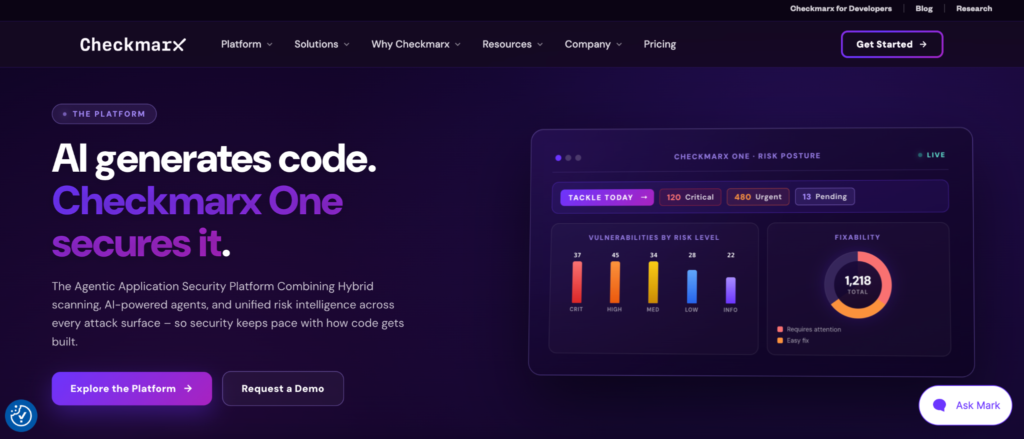
Checkmarx is often associated with application security testing. The broader platform reflects how much customer expectations have changed.
Organizations increasingly expect security platforms to provide visibility, prioritization, and remediation support alongside testing capabilities. Simply identifying vulnerabilities is no longer enough.
Checkmarx One addresses this through broader application risk management and security posture capabilities.
Capabilities include:
- Application risk visibility
- SAST
- SCA
- API security
- IaC scanning
- Container security
- Supply chain security
For organizations seeking AppSec coverage combined with posture management functionality, Checkmarx remains a strong contender.
ASPM Is Really About Decision-Making
The category is often described as a visibility problem. In reality, it is a decision-making problem.
Most security teams already know they have vulnerabilities. The challenge is determining which vulnerabilities deserve attention first, which teams should own remediation, and how progress should be measured over time.
That is where ASPM platforms create value. The strongest platforms help security teams spend less time sorting through findings and more time reducing actual risk.
Why ASPM Is Becoming a Priority for Security Leaders
Security programs continue generating more data every year. More applications. More dependencies. More cloud services. More containers. More vulnerabilities.
The volume is growing faster than most security teams. Hiring alone rarely solves the problem.
Prioritization becomes increasingly important because resources remain finite. Security teams cannot fix everything at once, which means deciding what matters becomes one of the most important functions in the entire security program.
That reality explains why ASPM has moved from an emerging category to a strategic priority.
Choosing the Right ASPM Platform
The best ASPM platform depends heavily on the environment it will support. Organizations with large security stacks may prioritize aggregation and visibility. Teams focused on vulnerability management may emphasize remediation workflows. Others may prefer platforms that combine posture management with security testing and cloud security capabilities.
For companies exploring Snyk alternatives, ASPM platforms often represent a natural next step. Instead of adding another security tool, they help organizations get more value from the tools they already have.
Platforms such as Aikido, ArmorCode, Vulcan Cyber, Nucleus Security, Veracode, and Checkmarx each approach that challenge differently, but all are designed around the same objective: helping security teams identify what actually matters before the next thousand alerts arrive.