
Top 5 Fintech Software Development Companies in 2026
One of the toughest challenges for fintech product teams is building a regulated payment infrastructure that actually scales without tripping over compliance issues like PSD2, PCI DSS, or new AI governance rules. Generic dev shops tend to struggle here.
They often lack the specialized knowledge to handle banking regulations, the technical maturity for large-scale platforms, and the kind of long-term support you need once your codebase becomes central to your business.
A lot of those fintech development roundups hide these gaps behind buzzwords about “innovation.” You might not notice until due diligence — or worse, halfway through the project.
We narrowed it down to companies that bring together real-world track records in regulated payments and banking, solid AI/ML integration with cloud architecture, and experienced leaders who think strategically. These top fintech software development companies stand out in payments, lending, and digital banking, where precision and engineering depth aren’t optional.
The Fintech Development Challenge in 2026
Fintech teams face a brutal tradeoff. Regulatory pressure keeps climbing. Legacy systems demand modernization.
Yet most development shops treat fintech like any other software project, missing the compliance depth and domain expertise these systems require. The real constraint isn’t finding developers—it’s finding partners who understand PSD2, PCI DSS, and the operational rigor of regulated financial systems.
Commodity outsourcing fails here. What separates winners from the rest is access to engineering teams that combine production-grade architecture with compliance expertise and stay invested long-term. Short-term staff augmentation won’t cut it when your payment platform touches customer funds, or your lending engine drives credit decisions.
The top fintech software development companies function as extensions of your product team, not vendors.
Key Services Offered by Fintech Development Firms
These companies deliver far more than code. They build payment infrastructure, modernize legacy banking systems, and create lending engines designed to pass strict regulatory checks.
Core offerings usually cover payment gateways, digital wallets, KYC/AML tools, fraud detection, and PSD2 open banking APIs. Many also support cloud migrations, blockchain settlements, and AI-driven credit scoring.
Above all, they weave compliance into every part of the project — treating certifications, audit trails, and reporting as essential engineering tasks. This focus is what separates real partners from standard vendors among today’s top fintech software development companies.
How to Choose the Right Fintech Software Development Companies
Selecting a strong fintech development partner requires careful checking beyond surface-level portfolios. You need proven regulated infrastructure experience, not standard app developers.
Key evaluation points include:
- Compliance track record: Ask for clear evidence of PSD2, PCI DSS, or SOC 2 certifications and talk to their clients in regulated environments.
- Infrastructure experience: Look for firms that build real payment systems at scale, not just basic integrations. They should know how to manage volume, reconciliations, and reliability.
- AI/ML capabilities: Verify they’ve put machine learning into production for fraud, credit decisions, or personalization using up-to-date cloud architecture.
- Domain expertise: See whether senior team members come from banking or compliance backgrounds and can speak strategy as well as code.
- Project breadth: Check their experience across payments, lending, and digital banking — it shows they can handle your specific situation.
- True partnership approach: Make sure they commit to long-term support instead of walking away once the project launches.
These criteria point you toward the top fintech software development companies that deliver lasting value.
Best Fintech Software Development Companies
Selected for regulated payments experience, PCI DSS compliance, and production fintech infrastructure. Each provides senior domain expertise across payments, lending, and banking—partners, not vendors. Detailed assessments of compliance, technical, and strategic capabilities follow.
SPD Technology
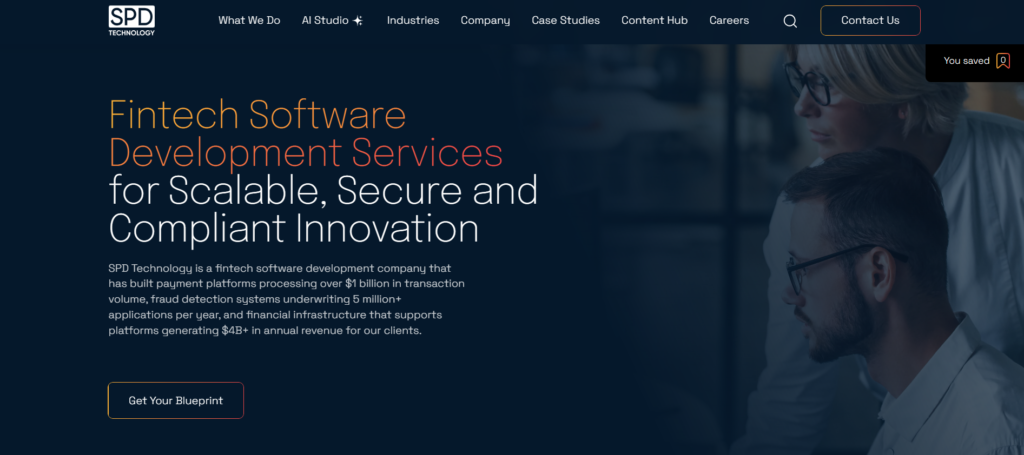
SPD Technology is a fintech engineering firm founded in 2006, specializing in payment systems, digital banking platforms, and AI-driven financial applications. The company operates as a product engineering partner—a model focused on long-term collaboration rather than transactional vendor relationships.
The firm supports regulated clients across the UK, US, and EU, with systems architected to meet PSD2 and PCI DSS compliance standards. Their work is concentrated on high-stakes financial environments where uptime, regulatory adherence, and transaction accuracy are non-negotiable.
SPD’s project portfolio includes payment processing, billing automation, lending infrastructure, and fraud detection solutions.
The company leverages cloud-native architecture and specialized financial services expertise to deliver platforms that maintain reliability and compliance under growing user demand and increasingly complex regulatory requirements.
Pros
- 18+ years of fintech software development experience
- Strong expertise in custom payment platforms, billing systems, and digital banking
- PSD2 and PCI DSS compliance knowledge for regulated markets
- Experience delivering projects across the UK, US, and EU
- Product engineering partnership model focused on long-term collaboration
- AI-driven fintech development capabilities, including fraud detection and automation
Cons
- Primarily focused on custom development rather than packaged fintech products
- Best suited for regulated fintech projects rather than simple MVPs with minimal compliance requirements
DashDevs
DashDevs was founded in 2010 and acts as a true fintech native. They bring senior-level domain knowledge and real compliance expertise instead of operating like a standard engineering vendor.
Their main strength lies in payments and lending technologies. They’ve successfully delivered BNPL solutions and large-scale deployments for both startups and established companies. They’re particularly good in regulated settings.
Rather than treating compliance as an add-on, they combine solid product engineering with a sharp commercial sense. They understand how to build payment systems that not only work technically but also drive revenue, cut churn, and meet auditor requirements at the same time.
What really stands out is their boardroom-level approach. They design solutions that pass regulatory checks while speeding up time-to-market. Thanks to their repeated work in payments and lending, they’ve handled PSD2, KYC/AML, and cross-border issues many times. This experience helps new teams avoid months of trial and error.
Pros:
- Deep payment/lending domain expertise with compliance baked into delivery
- BNPL and large-scale fintech deployment track record
- Senior-level commercial instinct alongside engineering execution
Cons:
- No published pricing or engagement model details on site
- Limited public case studies documenting specific client outcomes or ROI
DeepInspire

DeepInspire was founded in 2000 and brings more than 25 years of focused fintech software development experience. They work with clients who need to balance compliance, innovation, and real business results.
Unlike standard dev shops that treat fintech as just another industry, DeepInspire operates as a boutique partner. They connect business goals with technology, drawing on strong knowledge in online banking, trading, payments, wallets, and investment management. This helps them design solutions that meet regulatory requirements while supporting revenue growth.
Their work covers blockchain, personal finance, and regulated products, which makes them especially useful for next-generation infrastructure projects. They handle the details well — for example, building payment platforms that scale under PSD2 rules while keeping a smooth user experience, or trading systems that manage both speed and proper audit trails.
Pros:
- 25+ years specialized fintech engineering across payments, banking, trading
- Boutique model combining technical depth with boardroom-level commercial strategy
- Blockchain and regulated product expertise beyond vanilla web development
- Deep domain fluency translates to fewer costly compliance surprises mid-build
Cons:
- No documented AI/ML capabilities or modern cloud-native architecture focus compared to competitors, investing heavily in intelligent automation
ScienceSoft
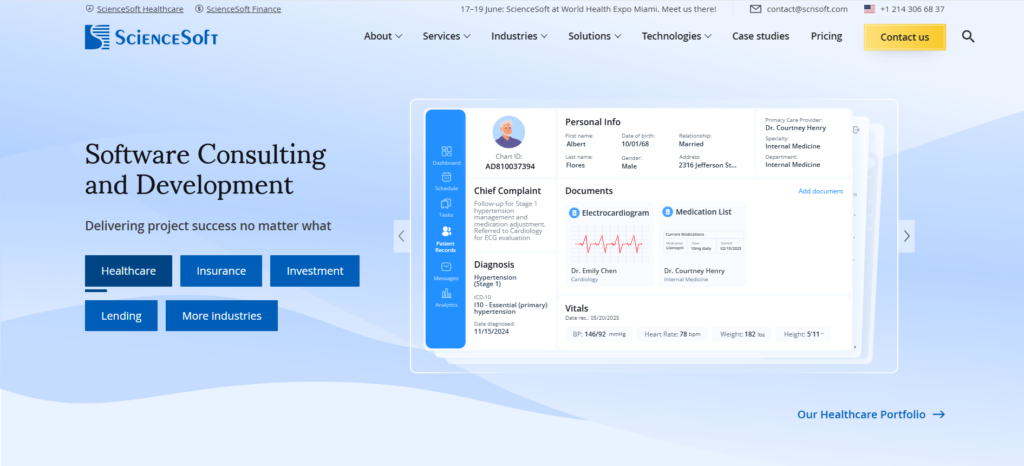
ScienceSoft was founded in 1989 and brings over 750 consultants and engineers, along with more than 4,200 completed projects. That kind of scale is hard for smaller fintech specialists to match.
They offer a full range of services, including AI implementation, custom software development, and data analytics tailored for fintech. This makes them a strong full-stack partner for enterprises that need both solid, regulated infrastructure and smart automation.
They blend deep industry knowledge with up-to-date technology, which works well for digital banking platforms, payment gateways, and lending products that require strict compliance alongside modern cloud setups.
What really stands out is how they focus on delivering real business results even when timelines and resources are tight. That’s especially useful when regulatory deadlines or market opportunities don’t leave much room. Their extensive enterprise experience helps them handle complex stakeholders, long-term roadmaps, and the technical debt common in modernizing legacy systems.
Pros:
- Consistent on-time project delivery
- Cost-effective compared to major IT firms
- Strong compliance and security expertise
- Experience in the healthcare and energy sectors
Cons:
- Less specialized in advanced niche AI/ML projects
- Post-launch support quality may vary according to client feedback
10Pearls
Since its founding in 2004, 10Pearls has built a reputation as an AI-first engineering firm with solid fintech expertise. They integrate machine learning at the architectural level rather than as an afterthought, focusing on AI capabilities, mobile and web development, and cloud migrations for financial services.
Their approach blends technical precision and product strategy to help startups and enterprises create platforms featuring predictive analytics, fraud detection, and personalized experiences. They serve clients in healthcare, finance, and retail with end-to-end support from discovery to ongoing optimization.
Particularly strong in lending platforms, embedded finance, and AI wealth tools, 10Pearls uses a global delivery model that balances cost efficiency with senior oversight. Teams working on regulated payments should verify PSD2 and PCI DSS experience upfront.
Pros:
- Deep AI/ML capabilities embedded at the product strategy layer, not just implementation
- Proven track record across fintech, healthcare, and retail with intelligent digital solutions
- End-to-end delivery model from discovery through deployment and optimization
Cons:
- No published emphasis on PSD2, PCI DSS, or other fintech-specific regulatory frameworks
- Broader industry focus may dilute depth in regulated payment infrastructure vs. pure-play fintech specialists
Quick Comparison
Scan this table to match your fintech project’s regulatory requirements, technical depth, and partnership model—each firm brings distinct strengths in compliance, AI integration, and domain expertise.
| Firm | Core Fintech Specialization | Compliance & Regulatory Focus | Best For |
| SPD Technology | Custom payment platforms and billing | PSD2/PCI DSS across UK/US/EU | Regulated payment infrastructure |
| DashDevs | Payment and lending technologies | BNPL and compliance-first builds | Startups to enterprise payments |
| DeepInspire | Banking, trading, wallets, blockchain | Regulated financial products | Boutique fintech with business depth |
| ScienceSoft | Enterprise software and data analytics | Multi-industry compliance experience | Large-scale enterprise fintech projects |
| 10Pearls | AI-native product development | Strategic compliance integration | Intelligent digital product launches |
Conclusion
Most searches for fintech development partners still pull up generic software shops that don’t have the necessary regulatory experience or real AI capabilities.
The truth is, the fintech space needs teams that bring together regulated infrastructure know-how, practical AI innovation, and a genuine long-term commitment. The five firms highlighted here actually deliver on all three. Each one has solid PSD2 and PCI DSS compliance experience, proven payment infrastructure that works at scale, and senior experts who can turn high-level ideas into robust platforms.
One quick note: pricing varies quite a bit depending on whether you go with a boutique specialist or a larger provider, so it’s smart to get clear on budgets early.
Start by matching your compliance needs against these top fintech software development companies, then ask for architecture proposals that cover both your immediate launch and a realistic three-year scaling plan. At the end of the day, regulated fintech work calls for true engineering partners, not just commodity vendors.